✨ AI Prospecting: The future of prospecting for SMBs is here — sign up for early access.


Here's a conversation that happens constantly in the United States vertical SaaS world:
"Are there really enough HVAC companies out there to build a business?"
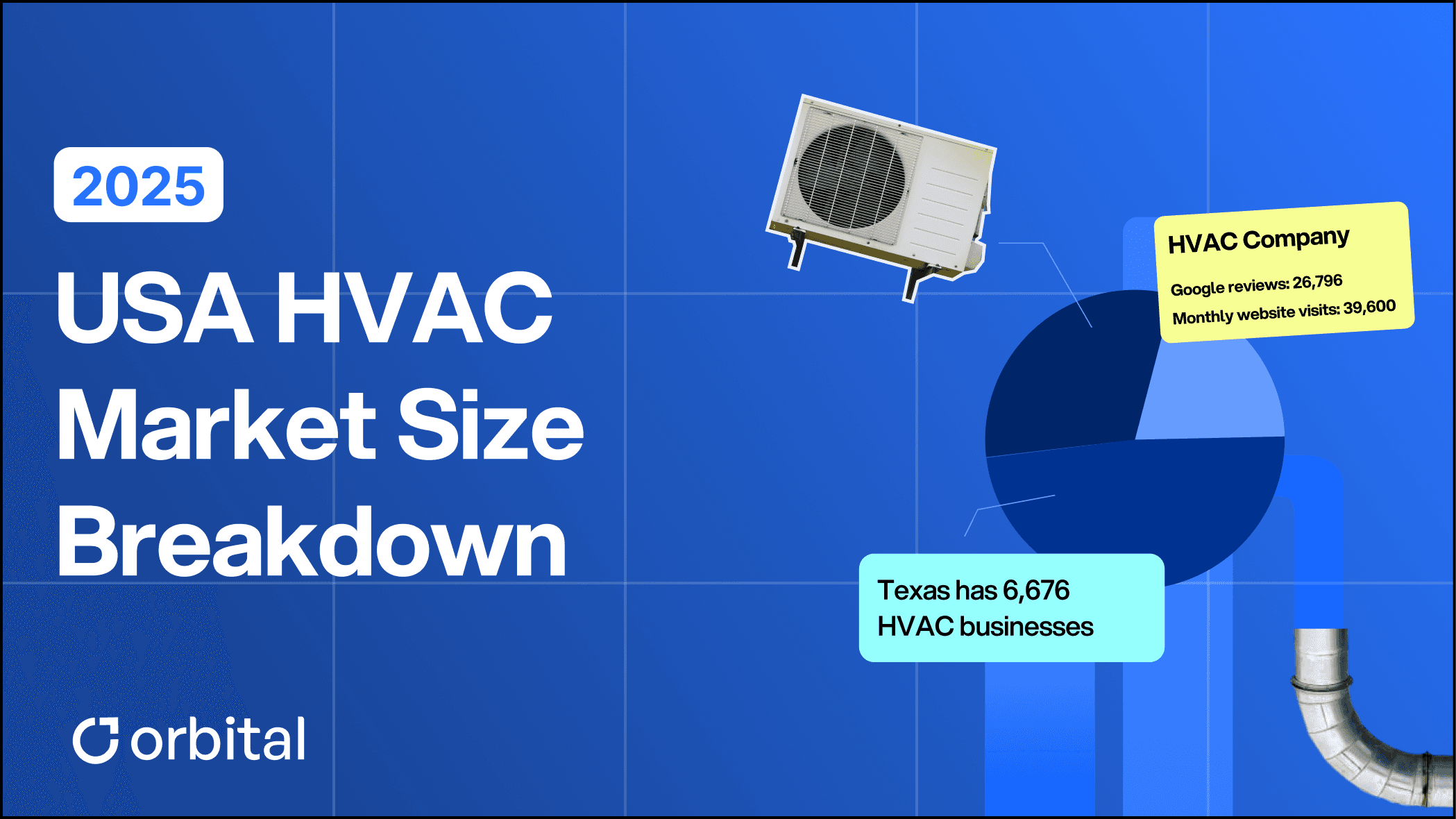
The answer: The country has 169,827 HVAC businesses. With Texas alone comprising 16,673. That's just ONE state.
If you're building software for field services, selling to HVAC companies, or investing in this space, these numbers define your TAM.
Our analysis uses real data from analyzing actual HVAC businesses - their technology choices, digital presence, and contact data quality.
Not estimates. Not assumptions. Real businesses using real software.
Here's what the data tells us about the US HVAC market.
The US Market Is Bigger Than Expected
As we stated earlier, the United States has 169,827 HVAC businesses. That's the total addressable market if you're selling to HVAC companies nationally.
But we’ll start with Texas: 16,673 HVAC businesses in a single state.
Why does this state serve as a useful proxy? When founders worry about TAM, they're often thinking too small. "Maybe there are a few thousand HVAC companies..."
Texas alone disproves that. 16,673 businesses is substantial. It's enough to build a meaningful software company focused on a single state before expanding elsewhere.
The market penetration math: If you're selling to HVAC companies at $500/month and capture just 1% of Texas. That’s 167 customers, $83,500 monthly recurring revenue, ~$1M annual recurring revenue
At 5% market penetration: 834 customers, $417,000 MRR, ~$5M ARR.
At 10% market penetration: 1,667 customers, $833,500 MRR, ~$10M ARR.
The HVAC market TAM question shouldn’t be, "Is there enough market?"
It needs to be, "Can you execute well enough to capture a meaningful percentage?"
Scaling beyond Texas:
With 169,827 HVAC businesses nationally, Texas represents about 10% of the total US HVAC market. If you can successfully penetrate Texas, you have a roadmap for expansion. The same playbook. The same messaging. The same integration strategy. Just applied to additional states.
Why this matters for selling to HVAC companies:
You don't need to conquer all 169,827 businesses simultaneously. You need to focus on markets where you can execute well, build customer references, and establish presence.
Start with one state. Prove the model. Then expand.
Texas provides enough concentration to validate product-market fit without the complexity of managing a national go-to-market strategy from day one.
The practical implication:
When people say the HVAC market is "too niche," they're wrong. 169,827 businesses nationally. 16,673 in Texas alone. This is a massive market opportunity waiting for companies that understand how to reach it.
3 Companies Control The Market
When selling to HVAC companies, understanding their technology stack is important.
The Field Service Management (FSM) software market shows extreme concentration. FSM Market Share (by customer count):
Housecall Pro: 39%
ServiceTitan: 34%
Thryv: 19%
Jobber: 4.3%
Workiz: 0.8%
Other: 2.3%
Three companies control 92% of HVAC companies using FSM software.
What triggered this consolidation:
FSM platforms become deeply embedded in HVAC business operations. Job history, customer records, technician workflows, dispatch processes - everything lives in the FSM.
HVAC companies don't switch platforms casually. Once they choose, they typically stay for years.
Market consolidation creates momentum. More customers means more integrations, more integrations mean more value for new customers, and more value means more customers. The winners keep winning.
Understanding each major player:
1. Housecall Pro (39% - Market Leader by Customer Count)
Leading the HVAC market with the highest customer count. 39% of HVAC businesses using FSM have chosen Housecall Pro. When selling to HVAC companies, this is statistically the most likely platform you'll encounter.
2. ServiceTitan (34% - Close Second)
Second by customer count at 34%. Likely leads in revenue given their positioning toward larger HVAC companies. Strong presence among growth-stage HVAC businesses.
3. Thryv (19% - Third Position)
Holds 19% of the HVAC market FSM space. Nearly one in five HVAC companies using FSM software chose Thryv.
4-7. The Long Tail (8%), Jobber (4.3%), Workiz (0.8%), and other platforms (2.3%) split the remaining market.
Why this matters when selling to HVAC companies:
Integration Priority: Build integrations for Housecall Pro and ServiceTitan first. That's 73% of the HVAC market accessible with two integrations. Add Thryv, and you've covered 92% of HVAC companies using FSM.
Segmentation Strategy: You can target HVAC businesses based on which FSM they use. Different platforms often indicate different company characteristics:
Business size
Technology sophistication
Budget allocation
Growth stage
Messaging Customization: When selling to HVAC companies using ServiceTitan, your pitch emphasizes different value propositions than when selling to Housecall Pro users.
Platform choice reveals priorities.
Partnership Opportunities: FSM vendors want their customers to succeed. Building integrations opens partnership conversations, marketplace listings, and co-marketing opportunities.
The strategic takeaway: Don’t consider the HVAC market fragmented across dozens of FSM platforms, but concentrated among 3 clear leaders.
This concentration simplifies everything about selling to HVAC companies:
Clearer integration roadmap
Better segmentation capability
More efficient partnership strategy
Simpler competitive positioning
HVAC Companies Are Digitally Sophisticated
Here's a stat that changes how you think about HVAC businesses: Parker & Sons, a major HVAC company, has 26,796 Google reviews.
The average HVAC company also generates 39,600 monthly website visits.
What these numbers tell us about the HVAC market:
These businesses are not struggling with "getting online", but have mastered digital marketing in ways most B2B companies haven't.
26,796 reviews don't happen by accident. It’s systematic review generation, operational processes built to request feedback from every customer, and years of consistent execution.
39,600 monthly website visits tell us they're showing up in search results. They're running campaigns. They're creating content. They're investing in digital presence.
Why this matters when selling to HVAC companies:
The biggest mistake in selling to HVAC companies is condescension. Assuming they need education about digital marketing, they don't understand metrics, and they're not measuring performance.
HVAC businesses are measuring everything:
Cost per lead from digital channels
Conversion rate from website visit to booked job
ROI on Google Ads spend
Review velocity and sentiment
Technician utilization rates
Average revenue per service call
The sales implication for the HVAC market:
When pitching to HVAC companies, lead with the data they already track.
"What's your current cost per booked job from digital leads?" is a better opening than "Have you thought about your online presence?"
Show peer examples. HVAC companies trust what other HVAC businesses have accomplished more than any software demo.
Talk about immediate ROI. These are business owners who think in margins and cash flow. If your software saves 15 minutes per service call, they can calculate exactly what that means in daily revenue.
Match their sophistication level:
Data-driven conversations
Peer comparisons
ROI calculations
Metric-based value propositions
The reality about selling to HVAC companies: They’re not unsophisticated buyers but operators who understand their business metrics better than most SaaS founders understand theirs.
The 26,796 reviews and 39,600 monthly visits are proof that HVAC businesses have figured out digital marketing. Your go-to-market strategy for the HVAC market needs to match that reality.
The Contact Data Problem Nobody Talks About
When selling to HVAC companies, contact data quality determines whether you can start conversations. Here's the coverage comparison:
Orbital: 70% coverage of HVAC business decision makers
ZoomInfo: 45% coverage
Apollo: 40% coverage
What "coverage" means for HVAC companies: Do you have valid contact information for the actual decision maker at HVAC businesses? Not a generic info@ email, or a disconnected phone number, or even an outdated contact who left the company.
The owner's direct email. The phone number they actually answer.
The coverage gap impact:
70% vs 45% tells us that in a list of 1,000 HVAC companies:
Traditional providers give you 450 valid decision-maker contacts
Orbital gives you 700 valid contacts
That's 250 additional reachable HVAC businesses per thousand targeted
Why Traditional B2B Data Struggles With The HVAC Market
Traditional data providers optimize for enterprise contacts:
LinkedIn profiles with clear job titles
Corporate email formats ([email protected])
Business phone systems with extensions
Office locations with suite numbers
HVAC business owners don't fit these patterns:
Limited LinkedIn presence (60% don't have active profiles)
Personal email addresses ([email protected])
Cell phone as a business line
Home address often equals business address
Different digital footprint requires different data collection approaches.
The practical impact on selling to HVAC companies: More valid contacts means more opportunities to start conversations. If your outbound campaign targets the HVAC market, the difference between 70% and 45% coverage compounds throughout your funnel:
More conversations started
More meetings booked
More deals in the pipeline
More revenue generated
Don’t think about data quality, but whether you can actually reach the HVAC companies you want to sell to.
Strategy For Selling To HVAC Companies
From data to action - what this means for selling to HVAC companies:
1. Start with Geographic Focus
Don't try to sell to all 169,827 HVAC businesses simultaneously. Start with Texas (16,673 HVAC companies) or another concentrated market. Prove your model. Build references. Establish presence. Then expand to additional states using the same playbook.
2. Segment by FSM Choice
When selling to HVAC companies, knowing which platform they use changes your approach.
Housecall Pro users (39% of market):
Likely mid-sized HVAC businesses
Value-conscious but growing
Looking for complementary tools
ServiceTitan users (34% of market):
Larger HVAC companies
Already paying a premium for software
Want sophisticated integrations
Thryv users (19% of market):
Smaller HVAC businesses
Want all-in-one solutions
Price-sensitive
Build separate lists. Customize messaging. Target strategically.
3. Build FSM Integrations
Two integrations (Housecall Pro + ServiceTitan) = access to 73% of HVAC companies using FSM. This simplifies your integration roadmap and maximizes HVAC market coverage with minimal development.
4. Match Their Digital Sophistication
HVAC businesses with 26,796 reviews and 39,600 monthly visits aren't unsophisticated buyers. When selling to HVAC companies:
Lead with ROI data
Show peer examples from the HVAC market
Discuss metrics they already track
Skip the "why digital matters" education
5. Fix Your Contact Data
If you're using traditional B2B data for HVAC market outbound, you're missing 50-55% of decision makers. 70% coverage vs 45% coverage directly impacts how many HVAC companies you can reach.
The execution reality: The HVAC market is large enough (169,827 businesses), concentrated enough (92% use 3 FSM platforms), and sophisticated enough (26,796 reviews average) to support substantial software companies.
Forget market size when selling to HVAC companies, think execution:
Can you build what they need?
Can you reach decision makers?
Can you convert them into customers?
Can you retain and expand them?
The data says there is HVAC market opportunity. What you do with it determines everything else.
The HVAC Market Opportunity: 169,827 Businesses Waiting
This analysis started with one question: "Is the HVAC market big enough?"
Here's what the data confirms:
1. 169,827 HVAC businesses operate in the United States. This massive market opportunity.
2. Texas alone has 16,673 HVAC companies - enough to build a substantial business before expanding nationally.
3. Three FSM platforms (Housecall Pro 39%, ServiceTitan 34%, Thryv 19%) control 92% of the market, making integration and targeting strategy straightforward.
4. The average HVAC company (e.g., Parker & Sons with 26,796 reviews) is digitally sophisticated - they understand metrics, track ROI, and demand data-driven conversations.
5. Contact data quality matters: 70% coverage vs 45% determines whether you can reach decision makers when selling to HVAC companies.
The HVAC market exists. The concentration simplifies strategy. The sophistication demands respect.
Want the complete breakdown? Download the full 2025 US HVAC TAM Report
State-by-state numbers for all 50 states
FSM market share by geography
Digital sophistication benchmarks
Contact data methodology
Outbound playbooks
*Powered by Orbital data - 70% HVAC owner coverage
Book a Demo
Identify, qualify, and engage at scale.
For companies underserved by ZoomInfo.

Book a Demo
Copyright © 2025 Carver Technologies
(Orbital AI)